If you are weighing up a career in medical imaging, the first question is usually the radiographer salary UK employers actually pay. In the NHS the answer is unusually transparent: radiographers are paid on the national Agenda for Change pay structure, new registrants typically start on Band 5, and every pay point for 2026/27 is published. This guide sets out the current figures for England and Scotland, explains London weighting, adds up the grants available while you train, and lists the regulator fees you will pay once qualified. All figures are for the 2026/27 pay year unless stated otherwise.
Radiographer salary UK 2026: the NHS pay bands
NHS Health Careers says diagnostic radiographers are paid under Agenda for Change and typically start at Band 5. In England, the 2026/27 rates took effect from April 2026 and include a 3.3% pay award. The Department of Health and Social Care said in March 2026 that around 1.4 million Agenda for Change staff had already received the 3.3% award, backdated to 1 April 2026, and that it reached pay packets from April for the first time in six years.
Each band has three pay points. You move up according to time in the band rather than through annual negotiation, so your salary path is predictable from day one.
| Band | Entry point | Middle point | Top point |
|---|---|---|---|
| Band 5 | £32,073 | £34,592 | £39,043 |
| Band 6 | £39,959 | £42,170 | £48,117 |
| Band 7 | £49,387 | £51,932 | £56,515 |
| Band 8a | £57,528 | £60,417 | £64,750 |
For Band 5, NHS Health Careers shows the entry rate for staff with under two years in the band, the middle rate from two to four years, and the top rate after four years. Bands 6 to 8a show what you would earn if you later move into a post graded at that level; which band a particular job sits on is set by the employer and shown on each advert.
England and Scotland compared
Scotland sets its own Agenda for Change rates and applied a 3.75% uplift from 1 April 2026. The result is that the same band is worth noticeably more north of the border.
| Band | England entry | Scotland entry | England top | Scotland top |
|---|---|---|---|---|
| Band 5 | £32,073 | £34,544 | £39,043 | £43,039 |
| Band 6 | £39,959 | £43,231 | £48,117 | £52,679 |
| Band 7 | £49,387 | £52,845 | £56,515 | £61,466 |
At the top of Band 5 the gap is £3,996 a year in Scotland’s favour. That does not automatically make Scotland the better move: housing costs, the Scottish income tax bands and the specific post all matter. But anyone comparing two offers on either side of the border should compare these basic rates first, then look at extras.
London weighting and how it changes your pay
In England, posts in and around London attract a high cost area supplement on top of basic pay. NHS Health Careers lists three zones for 2026/27:
- Inner London: 20% of basic salary, with a minimum of £5,794 and a maximum of £8,746.
- Outer London: 15% of basic salary, minimum £4,870, maximum £6,137.
- Fringe: 5% of basic salary, minimum £1,346, maximum £2,270.
The minimums and maximums matter more than they first appear. On lower salaries the percentage can fall below the floor, so you receive the minimum instead; on higher salaries the cap stops the supplement growing.
Worked example: a newly qualified radiographer in London
Take a new graduate starting on the Band 5 entry point of £32,073 in England.
- Inner London: 20% of £32,073 is £6,414.60. That sits between the £5,794 floor and the £8,746 cap, so it is paid in full. Total: £38,487.60 a year.
- Outer London: 15% of £32,073 is £4,810.95. That is below the £4,870 minimum, so the minimum applies instead. Total: £36,943 a year.
- Fringe: 5% of £32,073 is £1,603.65, inside the range. Total: £33,676.65 a year.
So the same first job can be worth anything from £32,073 to just under £38,500 before tax, depending only on where the hospital sits. When you compare vacancies, always check which zone, if any, the employer is in. These figures are gross annual pay before tax, National Insurance and pension contributions, and exclude any payments for unsocial hours or on-call work.
Training routes and money while you study
NHS Health Careers sets out three main ways in. An undergraduate degree takes three or four years full time, or up to six years part time. Graduates with a relevant first degree can take a postgraduate route, some of which last two years. A degree apprenticeship lets you earn while studying, with tuition paid by the employer and government; because of that, apprentices are not eligible for student grants. Typical undergraduate entry asks for five GCSEs at grade 4 or above, including English, maths and science, plus two or three A levels including a science such as physics, chemistry or biology, although each university sets its own requirements.
Students on approved courses in England can apply to the NHS Learning Support Fund. The government guidance for the 2026 to 2027 academic year, published on 24 July 2026, confirms these non-repayable, non-means-tested payments:
| Payment | Amount per academic year | Who qualifies |
|---|---|---|
| Training Grant | £5,000 | Eligible students on approved courses, including diagnostic and therapeutic radiography |
| Specialist Subject Payment | £1,000 | Radiography students on courses that started after 1 September 2020, among other specialist subjects |
| Parental Support | £2,000 | Students with parental responsibility for a child under 15, or under 17 with special educational needs |
Put together, a radiography student without children can receive £6,000 a year in grants, which matches the figure quoted by NHS Health Careers. Across a three-year full-time degree that adds up to £18,000, on top of the usual student finance loans. Eligibility depends on qualifying for tuition fee and maintenance loans, so check the rules before you apply, and remember that students paid a salary by an employer while they train are excluded.
Registration and HCPC fees
You cannot practise as a radiographer until you are on the register of the Health and Care Professions Council (HCPC). According to the HCPC register summary, 49,382 radiographers were registered, with data dated 2 November 2026.
The fees below have applied since 29 April 2025:
- Scrutiny fee for an approved UK programme: £86.34, paid once when you apply.
- Standard registration and renewal: £123.34 a year, paid as part of a two-year cycle.
- New graduate registration: £61.67 a year, a 50% discount for your first two full professional years if you apply within two years of finishing your course.
Most people pay in a two-year renewal window, and the HCPC also offers payment by direct debit. The HCPC says it aims to review its fees at least every two years, so check the current rate before you budget for renewal.
Getting hired and moving up
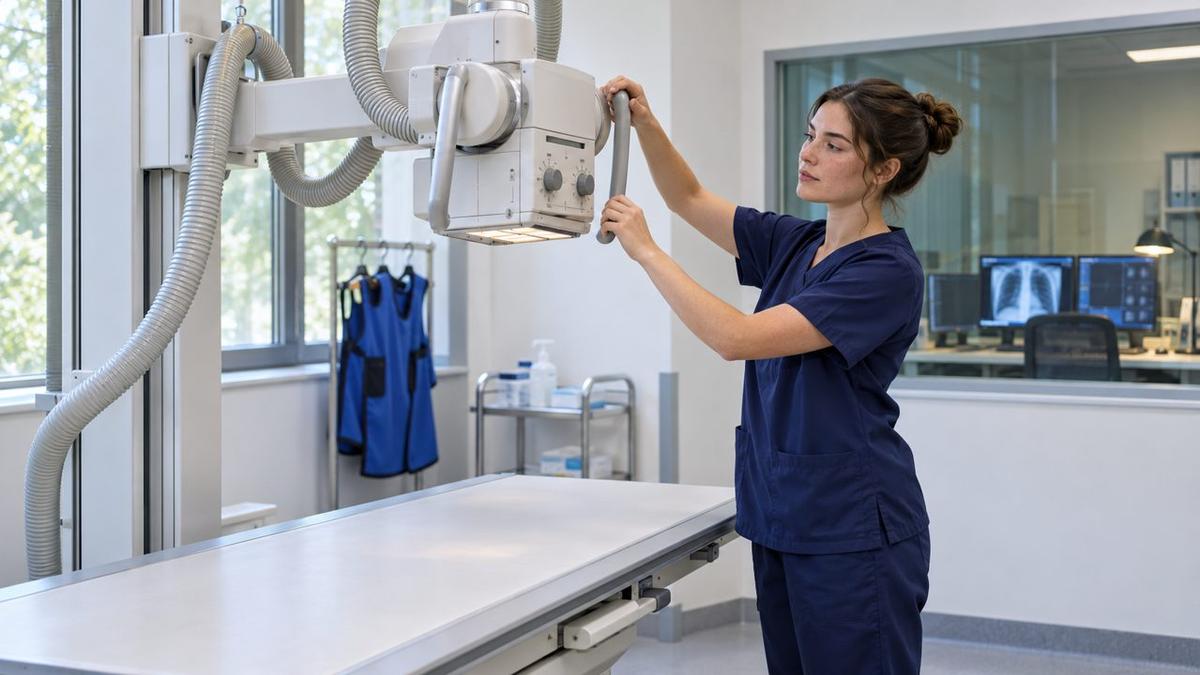
Diagnostic radiographers are mostly based in hospitals, working in multidisciplinary teams that rely on X-ray, CT and MRI to reach a diagnosis. NHS Health Careers lists specialisms such as CT scanning, sonography after further training, and work with children, stroke patients or cancer patients, as well as research, teaching and leading a radiography team. The standard week is around 37.5 hours, often worked flexibly across seven days, with 27 days’ annual leave plus bank holidays.
Practical steps that make a difference:
- Keep a short, structured CV that lists your clinical placements, modalities you have used and your HCPC registration status. Our free CV builder can produce one in minutes.
- Read the band and the high cost area zone on every advert before comparing salaries.
- Look at neighbouring allied health careers too. Our guides to physiotherapist pay and paramedic pay use the same Agenda for Change structure, which makes side-by-side comparison easy.
- Browse current openings on the ScrollJob jobs board and filter by location.
Frequently asked questions
How much does a newly qualified radiographer earn in England?
Most start on Band 5. From April 2026 the entry point is £32,073 a year before tax, rising to £34,592 after two years in the band and £39,043 after four.
Do radiographers earn more in Scotland?
On basic pay, yes. The 2026/27 Scottish Band 5 runs from £34,544 to £43,039, compared with £32,073 to £39,043 in England.
Is there a bursary for radiography students?
In England the NHS Learning Support Fund pays a £5,000 Training Grant plus a £1,000 Specialist Subject Payment for radiography each academic year in 2026 to 2027, with an extra £2,000 for eligible parents. None of it has to be repaid.
Can I become a radiographer through an apprenticeship?
Yes. Degree apprenticeships let you earn while you study, with tuition paid by your employer and the government. Apprentices cannot also claim student grants.
How much is HCPC registration?
The standard fee is £123.34 a year. New UK graduates pay £61.67 a year for their first two full professional years, and there is a one-off £86.34 scrutiny fee when you apply.
Does London weighting apply to every radiographer job?
No. The high cost area supplement applies only to posts in the Inner London, Outer London and fringe zones in England, and the percentage is subject to a minimum and a maximum.
Conclusion
Radiography offers one of the clearest pay pictures in healthcare. In England a new registrant starts on £32,073 and reaches £39,043 at the top of Band 5, with London weighting adding up to several thousand pounds more. Scotland pays more on every band. Training is supported by £6,000 a year in non-repayable grants for most students, and the main ongoing cost of practice is an HCPC fee of £123.34 a year. Check the band, zone and nation on every advert, and you will know almost exactly what a job is worth before you apply.
Sources: NHS Health Careers (Agenda for Change pay rates and diagnostic radiographer role profile); Department of Health and Social Care media blog, 26 March 2026; Scottish Government, NHS staff pay rates for Agenda for Change staff; GOV.UK, NHS financial support for health students, 10th edition, NHS Learning Support Fund; Health and Care Professions Council, registration fees and register summary.